
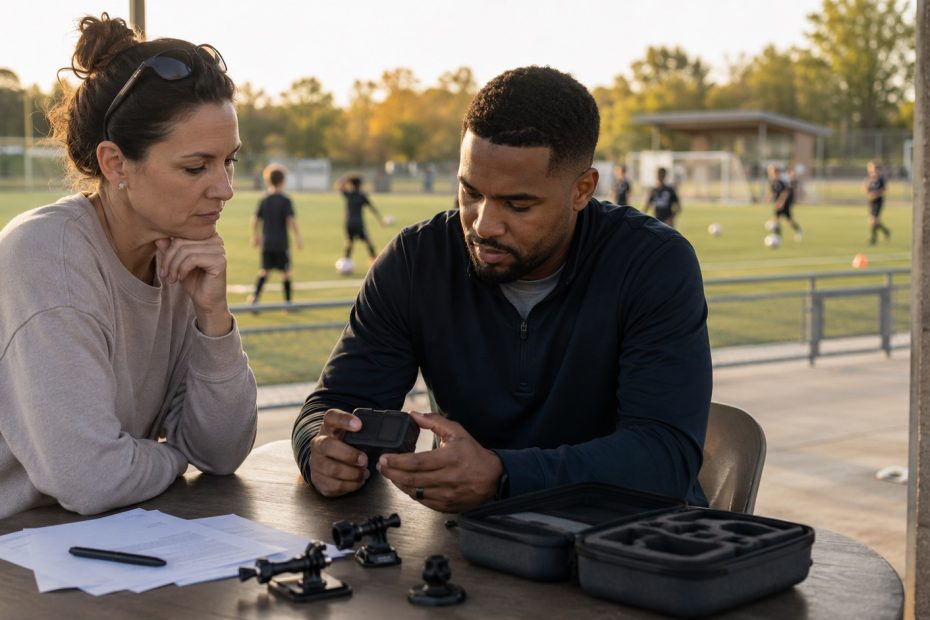
In February 2026, Georgia Soccer announced that every participating team could get a free Trace camera kit. Ohio followed in March, Florida in April naming Trace its official video partner, New Jersey in June. When entire state governing bodies start acting as the distribution channel for a piece of sports technology, that technology has moved to a different stage of its life.
Here’s what is actually being distributed at that scale. It is an always-on AI camera that identifies individual children by jersey number and wearable sensor, tracks each one through the match, cuts their moments into a personalized highlight playlist, stores the footage in the cloud, and makes it shareable with families, coaches, and college recruiters — including footage of children on the opposing team, and children whose families never signed up for anything.
That’s not a reason to refuse it. Plenty of clubs will decide the trade is worth making, and they may be right. But it is the part of the offer that no announcement leads with, and it is the part a club or a parent should be able to answer before the first camera goes up on a pole.
Four questions to answer before you say yes
Not “is this technology impressive.” It is. These four:
Who owns the footage? Not who can watch it — who holds it. The club, the state association, the vendor, or the subscribing family? The answer determines what happens to five years of video if the club changes vendors, the association ends the deal, or a family leaves.
Who can access a given child’s video, and how is that enforced? Coaches and parents on the roster is one answer. Recruiters is a much larger one. A shareable link is larger still, because a link forwards.
How are opposing and non-subscribing kids handled? A camera that follows the ball films both teams. A camera that identifies players by number and sensor is doing something more specific to the children it was set up to track — but the children on the other side of the halfway line are in the footage either way, and their parents made no decision at all. Same for the family on your own roster that declined to subscribe: they still appear.
What’s the consent model, and what’s the retention period? Was consent obtained per season, per family, per child? Can it be withdrawn? Does withdrawing remove past footage or only stop future recording? How long is video kept, and what happens to it when a player ages out?
None of those are exotic questions. They’re the ordinary ones any organization holding data on minors should be able to answer in writing. The gap worth noticing is that the technology arrived at statewide scale considerably faster than the answers did — and a free camera creates real pressure to skip the conversation, because the thing that usually forces a club to think carefully is a purchase order, and there isn’t one.
It’s also worth heeding one independent note of caution already in the discussion: whether downloadable, personalized footage of every child reduces sideline friction or quietly feeds it. One youth coach’s take — that this is genuinely useful from roughly age 14 up, while younger kids mostly just need to play — is a healthier default than filming every U9 game like a scouting exercise.
What the camera actually does
Professional sports have treated video as infrastructure for years: film the game, tag the action, cut the clips, review individual players, share with coaches. The expensive part was never owning a camera. It was everything after someone pressed record — operating it, uploading, finding the right plays, editing them, organizing the material so a coach or player could use it.
Trace automates that workflow for youth sports. Its system pairs a wide-angle camera with wearable sensors the players carry, and its PlayerFocus AI identifies and follows each individual athlete, then generates personalized highlight playlists after the game. (Those are the company’s descriptions of its own product; the volume figures it publishes — thousands of games a week, more than a million highlights added weekly — are its own marketing numbers, so take them as a signal of scale rather than an audited fact.)
Recording every game is useful. Recording every player is the more interesting trick, and it’s the one that changes the privacy question rather than just the convenience one. Trace takes the home and away jersey colors and a player’s number, combines them with its sensors and other signals, and follows that athlete through the match. A general match video is a record of an event. A per-child indexed video library is a different kind of object — searchable by person, which is exactly what makes it valuable to a recruiter and exactly what makes it worth governing. A professional organization can pay analysts to build that by hand; a youth club can’t, and that’s what automation changed.
The distribution shift is why this is happening now
Follow the trajectory, not the feature. In April 2022, Trace raised a $47 million Series C led by Pelion at a $190 million valuation, bringing total funding to $65.2 million — investors betting that automated youth-sports video was a big market. What’s changed since is who does the selling. The technology has moved from something a particularly committed parent or ambitious team chooses to buy, toward something state soccer associations help put on sidelines by the thousand.
Twenty-five years in technology and entrepreneurship has taught me to watch for exactly that transition. The tell that a product has crossed from early-adopter curiosity to mass adoption usually isn’t a flashier feature — it’s the moment distribution stops being one-customer-at-a-time and becomes a channel.
That’s the stage Trace is in now, and it matters for the questions above in a specific way. When a parent buys a camera, one family has consented to one thing. When a state association distributes thousands of them, a governing body has effectively made a data-collection decision on behalf of tens of thousands of children, and the individual club is left implementing a policy nobody wrote down.
“Free” is a subscription, and here’s the arithmetic
The camera is free in a specific sense: you don’t buy it, you lease it, and a team qualifies once it has seven or more families on the roster. Watching live streams and getting notifications is free. But to actually use the footage — full-game playback, personalized highlights, downloads — families pay a PlayerFocus subscription: $180 a year for Basic, which won’t let you download and only shows your last five games, or $300 a year for Pro.
Twelve families each on Basic is roughly $2,160 a year for a single team. Georgia’s own launch dangled $100 off an annual subscription for the first hundred signups. The association gives you the razor; the blades are billed yearly.
None of that makes it a bad deal — shared across a team, it can undercut what old filming services cost. But it should be priced as the recurring subscription it is, not the freebie the word “free” implies. And notice how the pricing interacts with the access question: the cheapest tier keeps your child’s footage inside the vendor’s platform, since Basic won’t let you download it. The families paying least have the least control over the record of their own kids.
Recruiting pulls it in — and pulls the footage outward
There’s a reason this spreads fast: college recruiting. Families have long built highlight reels by filming games, wrangling files, and editing manually. Trace collapses much of that — players save clips to a profile, build playlists, and share them with coaches or recruiters — and Georgia Soccer explicitly pitched the system as a way to build reels for college coaches.
That creates a tidy adoption loop: parents want memories, players want clips, coaches want film, clubs want development tools, recruiters want evidence, and one system serves all five. It also creates the pressure that makes the access question hard to hold the line on. Every one of those five users has a reason to move a child’s footage one step further outward, and the last two aren’t family.
Just notice that the recruiting pitch also runs straight into the paywall — downloading and sharing the polished reel is a Pro feature — and that a highlight reel, however slick, is one input into recruiting, not a substitute for the grind of it.
The gap is closing unevenly
Resist the temptation to make this sound more complete than it is. A youth club with Trace does not suddenly have an NFL video department. Professional teams pair video with scouting data, biometrics, tactical analysis, dedicated analysts, and coaching expertise. A camera can’t manufacture that, and more footage doesn’t automatically produce better players.
What’s actually democratized is capability: individual tracking, automated filming, personalized clips, remote viewing, and recruiting assets, available without building the labor structure those workflows used to require. That’s a real change, and Trace isn’t alone in chasing it.
But there’s a difference between an amateur club acquiring a professional capability and one acquiring a professional obligation. Pro teams that hold player video hold it under contracts, unions, and staff whose job is compliance. A volunteer-run U14 club now holds a per-child, cloud-stored, shareable video library with none of that, handed to it for free by its state association.
So the decision isn’t whether the camera is impressive — it is — or whether it’s free, because in the way that matters most, it isn’t. It’s whether you can answer four questions before the season starts: who owns the footage, who can see it, what happens to the kids who never signed up, and what it will cost your families across a full year. Say yes when those answers sit right with you. Not because the hardware showed up at no charge.

Cassandra Toroian is a sports-tech entrepreneur and CEO/co-founder of Ruley, the AI “e-referee” serving tennis, pickleball, padel, golf, and soccer. With 25+ years building companies—and a background in finance (MBA) plus Python training—she’s also co-founder of Volleybird and author of Don’t Buy the Bull. A former Division I tennis player, she’s focused on using AI to make sport fairer and more accessible.