You’ve probably heard the dramatic predictions by now. Robots taking jobs. Artificial intelligence replacing entire professions. Offices filled with machines calmly doing everything while humans sip coffee and wonder what happened. Relax. The reality is far less cinematic and far more interesting.
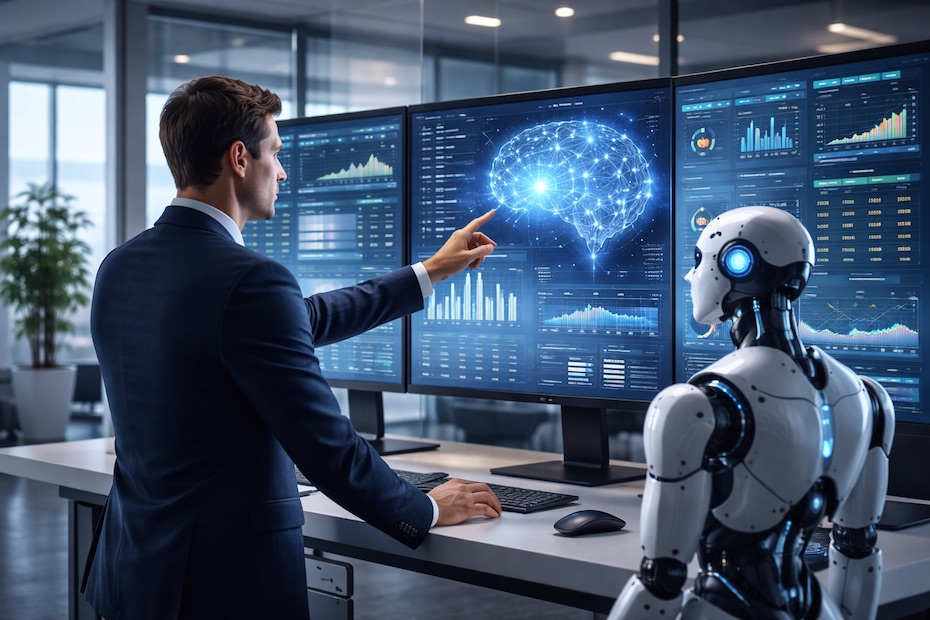
The truth is that the future of work in the AI era is less about replacement and more about partnership. AI isn’t lining up to steal your desk chair. It’s showing up as a very fast assistant who never sleeps, occasionally hallucinates facts, and absolutely needs supervision. The real question isn’t whether AI will replace you. The real question is whether you’ll learn to work with it before someone else does.
The Moment You Realize the Robots Aren’t Coming for Your Job (Exactly)
At first, you assume the headlines are right. Artificial intelligence will take over everything. Your job, your coworker’s job, maybe even the office coffee machine’s job. Hollywood has trained you well. If a computer gets smart enough, it probably becomes a villain with glowing red eyes.
Then you start paying attention to what AI tools actually do.
They write rough drafts. They summarize documents. They generate code suggestions. They analyze spreadsheets faster than your colleague who drinks five espresso shots before noon. Helpful? Absolutely. Perfect? Not even close.
The reality is that AI performs best when it handles repetitive cognitive work. Humans remain responsible for judgment, creativity, and decision-making. Studies from MIT and Stanford have shown productivity gains around 14% when workers use AI assistance tools. Translation: the technology works best when you’re still in charge.
Instead of replacing your role, AI quietly removes the annoying parts of it. Think of it as the intern who handles the tedious tasks while you focus on the strategic ones.
Your First Encounter with an AI Assistant That Feels Suspiciously Useful
You start experimenting. Maybe it begins with an AI writing assistant or a coding tool. Suddenly the work that normally takes two hours takes thirty minutes.
At first, you assume something must be wrong. This level of productivity feels suspicious. Like discovering a shortcut in a video game that skips three difficult levels.
Companies are noticing the same thing.
Research across large organizations shows AI can significantly boost productivity in roles involving writing, analysis, and data processing. Customer support teams using AI guidance systems resolve issues faster. Software developers using AI coding tools complete tasks more quickly. Marketing teams generate campaigns in a fraction of the time.
Instead of eliminating workers, companies begin redesigning roles around AI collaboration. Your job becomes less about producing raw output and more about directing intelligent tools.
Congratulations. You’re now the supervisor of a very fast digital assistant.
The Office Panic Phase (Also Known as the “AI Will Replace Everyone” Moment)
Every technological shift produces a brief period of panic.
Someone on social media declares that every profession will disappear by Tuesday. Your coworker insists accountants, designers, lawyers, and writers will all be replaced by algorithms before lunch.
Then reality steps in.
Organizations discover something important. AI handles structured tasks well but struggles with ambiguous decisions, leadership, and creativity. Human judgment still drives the final outcome in most complex situations.
Even the most advanced systems require oversight. They can process information quickly, but they cannot understand human nuance the way people do.
You begin noticing a pattern. The most successful professionals aren’t fighting AI tools. They are learning to use them.
And the results are impressive.
The Rise of the Human-AI Power Duo
Eventually, workplaces stop framing the situation as humans versus machines. The conversation shifts toward collaboration.
Doctors use AI systems to detect patterns in medical imaging. Engineers run complex simulations in seconds instead of hours. Financial analysts process massive datasets before making strategic recommendations.
None of these professionals disappear. They become more effective.
Large workforce studies reinforce this pattern. The World Economic Forum estimates that technological change may create about 170 million jobs while displacing around 92 million by 2030. The numbers point to transformation rather than elimination.
Your role evolves.
You spend less time gathering information and more time interpreting it. Less time performing repetitive tasks and more time solving meaningful problems.
In other words, AI becomes a productivity amplifier.
The Skills That Suddenly Matter More Than Ever
Something surprising happens as AI tools improve.
The most valuable human abilities become even more important.
Skills like critical thinking, creativity, leadership, and communication rise to the top of hiring priorities. Employers realize that machines can process information quickly but struggle with judgment and collaboration.
You notice this shift in everyday work.
Projects require strategic thinking rather than just execution. Teams expect you to interpret data instead of simply compiling it. Decisions rely on understanding human behavior rather than just reading analytics dashboards.
Ironically, the more technology advances, the more valuable human intelligence becomes.
The future workplace rewards people who combine technical literacy with uniquely human abilities.
The Workplace Where Everyone Quietly Uses AI
At some point, AI tools stop feeling like futuristic experiments.
They become normal.
Employees use them to research ideas, draft reports, analyze data, and automate repetitive tasks. Managers rely on them to evaluate trends. Developers integrate them directly into workflows.
Studies suggest that roughly three-quarters of knowledge workers already use AI tools in some capacity. Many do it quietly, like a secret productivity hack.
Once the technology integrates into daily work, the conversation changes.
Instead of asking whether AI will replace jobs, companies ask how employees can work more effectively with it.
Your ability to collaborate with intelligent systems becomes part of professional competence.
The Realization That the Future of Work Is a Team Sport
Eventually, the entire debate about AI replacing humans starts to feel outdated.
The workplace stops treating intelligence as either human or artificial. It becomes a blend of both.
Machines process enormous amounts of information quickly. Humans interpret that information, apply judgment, and guide decisions.
The combination works remarkably well.
You notice that the most effective professionals are not the ones resisting AI tools. They are the ones directing them.
Instead of competing with technology, they build workflows where AI handles repetitive tasks and humans focus on strategy, creativity, and leadership.
The future of work looks less like a robot takeover and more like a partnership.
Will AI Replace Human Jobs in the Future?
- AI automates repetitive tasks while humans focus on strategy and decision-making.
- Most jobs will evolve rather than disappear.
- Human-AI collaboration increases productivity.
- Workers who learn AI tools gain a major advantage in the future workplace.
Conclusion: The Future Isn’t Human vs AI — It’s Human With AI
If you were expecting a dramatic showdown between humans and machines, you might feel slightly disappointed. The future of work turns out to be less cinematic and far more practical.
Artificial intelligence excels at speed, pattern recognition, and data processing. Humans bring judgment, creativity, and the ability to navigate messy real-world situations. Combine the two and productivity jumps dramatically.
Your career advantage will not come from avoiding AI tools. It will come from learning how to guide them.
So the next time someone warns that machines are about to replace everyone, relax.
Your job isn’t disappearing.
You’re just getting a very powerful assistant.

Cassandra Toroian is a sports-tech entrepreneur and CEO/co-founder of Ruley, the AI “e-referee” serving tennis, pickleball, padel, golf, and soccer. With 25+ years building companies—and a background in finance (MBA) plus Python training—she’s also co-founder of Volleybird and author of Don’t Buy the Bull. A former Division I tennis player, she’s focused on using AI to make sport fairer and more accessible.